|
 In Harms
Way Page 2
In Harms
Way Page 2
Individual stories of the war years
from the people who lived them. These stories are sometimes heroic,
sometimes funny, sometimes poignant, or sometimes simply remembering
things that should never be forgotten.

|
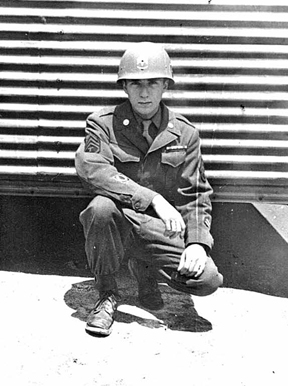
Sgt. Harry Paston - alongside Quonset hut barracks - 7th
Signal - Seoul, Korea - 1946
|
OKINAWA TO KOREA
1945-1946
In the summer of 1945 as the battle for Okinawa was winding
down for the 7th Infantry Division, after 89 days of combat
and approximately 7,100 casualties, I was serving with the
7th Infantry Division artillery.
With hostilities declared
ended except for pockets of scattered Japanese resistance
in caves, our thoughts were turning to the impending invasion
of the Japanese homeland. Germany had surrendered in May,
the conquest of Japan would end the war.
By Harry Pason
|
|
"A
Bloody new Yank Airplane"
Can
you make a Gooney Bird look like a Corsair? 2nd
Lt. Julius H. Peterson did! Here is his HAIRY story direct
from his own pdf report.
|
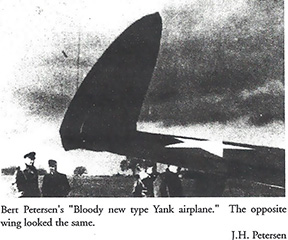
Bert Peterson's "Bloody new Yank airplane" The
opposite wing looked the same.
|
|
The
Rescue of the Danish Jews in the Latter Half of 1943
by
Peter Schaapman
"It is 1943. Europe is in a complete state of war.
The Endlösung, a term used by the Nazis for the destruction
of the Jews, is in full swing. In large parts of German
occupied Europe, Jewish children, women and men are being
murdered and captured, without much opposition from their
|
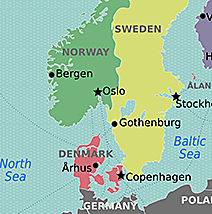
Occupied Denmark
and the narrow channel to free Sweden |
|
 Click
here for Click
here for
Peter's story
|
|
compatriots." Denmark
did not comply! They helped and protected their Jewish citizens!
A wonderful true story by Peter Schaapman in downloadable
pdf.
|
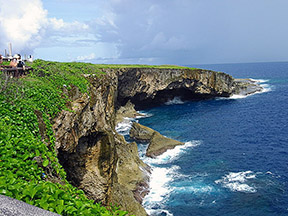 Banzai Cliffs, Saipan
where thousands of civilians died
Image thanks to Wikipedia
Clik the image for
a larger view |
Saipan!
Like movie star Lee Marvin
and
Otis (Swede) Welch, Richard
E. Salisbury landed troops on Saipan but in a LVT. Here
is his story in his own words — an audio presentation.
On June 15, while the D-Day battles were raging in France,
General A. (Howlin Mad) Smith led his Marines and Army forces
into one of the bloodiest battles of the Pacific. Lieutenant
General Yoshitsugu Saito knew his Japanese forces were doomed
but was determined to
make
it costly - he did. His entire garrison of
|
troops on the island
(at least 30,000) died - as did he. He made the battle the
most costly to date in the Pacific War. 2,949 Americans were
killed and 10,464 wounded, out of 71,000 who landed. "Hell's
Pocket", "Purple Heart Ridge" and "Death
Valley" entered the lexicon of the American invaders.
It was also the Japanese last banzai charge! The tactic that
worked so well in Manchuria but became a suicide charge when
Marine fire power opposed it. See Rainbow
over Hell for the story from the Japanese side.
As for the many Japanese
civilians, Saito said, "There is no longer any distinction
between civilians and troops. It would be better for them
to join in the attack with bamboo spears than be captured."
Emperor Hirohito joined in with an imperial order encouraging
the civilians of Saipan to commit suicide. The order authorized
the commander of Saipan to promise civilians who died there
an equal spiritual status in the afterlife with those of soldiers
perishing in combat. 1,000 Japanese civilians committed suicide
in the last days of the battle to take the offered privileged
place in the afterlife, some jumping from "Suicide Cliff"
and "Banzai Cliff" as Marines watched in horror
and pleaded for them to stop. See Saipan
Listen to Richard's own words about the battle.
|
|
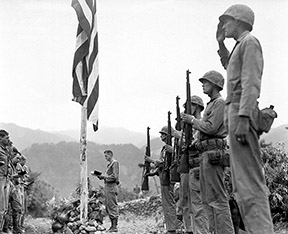
Troops singing Star Spengled Banner, Korea 1950.
Image posted on Yahoo
|

By Bill Kerrell
Foreword by the editor
I have known
the author of this story for more than three decades.
He a member of the "Silent Generation" that
fought the "Forgotten War." He is also a very
private person. I have managed
|
|
to find out, over all these
years that he has been a grossly mistreated child at the
Keene
Sanitarium at Keene, California (Now Chavez Center.)
This is a heart breaking story in itself. Read his "comment"
there.
He slept overnight in the
great pyramid (research for a book.) He has been an entrepreneur,
A Department of Corrections officer, a fast gun artist,
a published author, an executive, a manager, a business
man, a computer technician/guru, and now, at last, a teller
things that must be remembered about the Korean War.
All these years that I have known
Bill, I have never seen his spiritual side. On the other
hand, I have never seen a side of him that could be described
as not spiritual either. If you understand that, please
explain it to me. It is true but unexplainable. As he tells
his story, you can't help but feel his strong conviction
— born of near-death and war. He finished with a little
philosophizing which he has earned the right to do and the
right to be listen to.
Years ago, Bill was eager to talk about
his brother (See
My Brother Swede)
in WWII but for 30 years refused to
tell this story. I am honored to pass it on here. Don't
miss it!
|
|
"Pat you will
never get in there before they kill you. They are waiting
for you."
More on the brutal battle for Driniumor
River!
From
one who was there, Pat Bullock
By Ken Walters
|
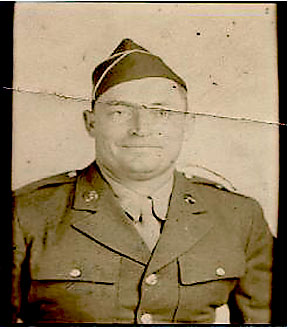
|
|
"A knife fight out
of the stone age,"
". . . some of the harshest terrain ever faced by land
armies in the history of the war,"
". . . one of the forgotten, grislier, campaigns of
WWII."
". . . most merciless and most primeval battles
This is a personal record
of this grizzly battle and is not for the faint of heart!
|
|
Market
Garden
by
Aubrey L. Ross
Lieutenant Colonel, USAF Retired
|
|
|
Editor's
Note: After the initial, and slightly surprising, success
of the landings at Normandy, the Allies hoped for a steady
push across France – maybe even home by Christmas.
What, Sadly, happened was that the Allies bogged down in
a virtual stalemate. In August, British Field Marshal Bernard
Montgomery pushed hard for what a later American general
would call a "Hail Mary." He wanted to make an
end-run around the battle through northern France, the low
countries, and into the industrial heartland of Germany,
the Ruhr. The largest airborne drop in history (to that
date) was made to capture and hold three strategic and a
few smaller bridges until the mass of land forces could
arrive. All went well except for a minor little detail lost
to Allied intelligence . . . the II SS Panzer Corps. Here
is the story from one who was there!
|
Click
here for
Aubrey's story
|
|
|
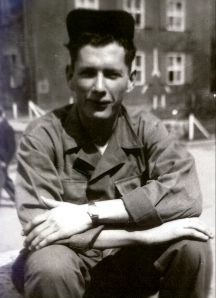 Sgt. Joe Tillery, 1945
|
The
First King Cobra shot down in America
The Flying Pinball Machine
Sgt. Joe Tillery
Another funny story from an USAAF
Sgt. who found something funny in everything that happened
to him in in WWII.
|
Click
here for
Joe's story
|
|
|
|
I will never forget the
feeling of being separated from that ship.
Adrift at Sea!
His ship, a small patrol
craft was completely disabled but afloat, Yeoman Barnes
watches as the ship that was towing them back to safety
dropped the tow and sped away . . . leaving them for weeks
in hostile waters.
|
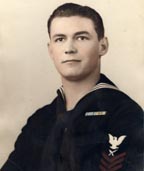
Bill Barnes, 1944
Click the image for
a larger view
|
|
Also,
Hall of Heroes
A
Paraglider Trooper
Remembers D-Day
The story of a young man
assigned to a Forward Observer Team to land via glider
behind German lines on the D-day landings. Like most of
the Horsa gliders, they didn't get down unscathed but,
injured, he went on to St. Marie Eglise and, indeed, the
rest of the bloody march across Europe, including Operation
Market Garden. Click the star for the story. See
the Market Garden Quiz. See
The Market Garden Story
|
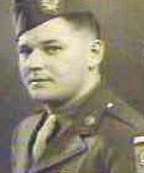
Alfred (Fritz) Joseph Nigl,
PFC
|
Click
here for
Fritz's story
|
|
|
Milo Smith, 1945
|
But not in 1950, in 1945
Inchon Landings!
By Milo Smith
|
Click
here for
Milo's story
|
|
|
|
Keeping
China Alive
Tales of "Flying the Hump."
By Charles R."Bob"
Pitzer
|
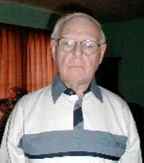 Charles R."Bob" Pitzer
 |
|
The Japanese
occupation of China, begun in 1937, had sealed off the country
from the rest of the world. By 1940, Japan controlled the
entire coast of China forcing Chiang Kai-shek's army westward.
In May 1941 President Roosevelt decided that the defense
of China was vital to American security, making that country
eligible for lend-lease assistance. The only way for American
lend-lease materiel to reach Chiang Kai-shek's army was
via the Burma Road which was a narrow, twisting route through
the mountains (Himalayas) that connected Lashio, Burma,
with Kunming, China. In May 1942, Japan's successful invasion
of Burma closed this last route for lend-lease aid into
China.
China National
Aviation Corporation (CNAC) developed and pioneered routes
over the Hump from India to China but it fell to the US
Army Air Forces to use them to supply the remaining Chinese
army. Americans quickly established ‘the Hump,' an
airlift of troops and supplies over the Himalayas designed
to keep Chiang Kai-shek's army in the fight
|
Click
here for
Bob's story
|
|
In July, 1945,
when the author (Charles Pitzer) was flying the
Hump, 71,000 tons of cargo was carried. In all, some 650,000
tons of gasoline, munitions, materiel,
and men were flown over the Hump. More than half was carried
in the first nine months of 1945.
Here are some
stories from one who was there!
|
|
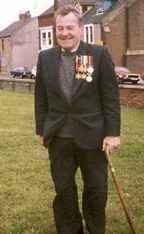
Joe Elliott with
his medals.
Taken on Remembrance Day 11/11/1999 by the village monument.
Click image for a larger view
|

THE WAR MEMORIES OF A BOMBARDIER
By
Joe Elliot
Joe, who told us the wonderful story, Birds
Eye View remembers more. After maritime service, Joe
was in the thick of it - from Norway to Bombay - never losing
his sense of humor. Don't miss this wonderful story from
a British bombadier's viewpoint.
|
Click
here for
Joe's story
|
|
|
NAS
Richmond in 1943
Lighter-than-Air combat
Know how to fly a blimp? Fight a German
U-boat or how it feels to fly through the air in a hurricane
so severe that it destroys three huge"hurricane proof"
Hangars? Arch McCleskey
takes us there as he describes his adventures as a crewman
on WWII blimps.
See
NAS Richmond now |
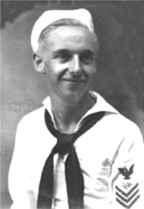
Arch H. McCleskey Jr.
in 1943 |
|

Art
and Micky Morneweck
|
More on
the first American troops in Korea
Korea, 1945
The first American
troops in Korea were sent there to take the Japanese surrender.
Art Morneweck was there during this almost forgotten episode.
A tiny group of GI's move in to secure a country that had
been brutalized by Japanese occupation.
|
|
Perilous Duty in Wonsan
Bay in 1951-1952
Korea, 1951!
What was it like as you deliberately
force your way through mine infested waters? After all,
that's why you are there -- to find the mines and destroy
them. Did it help when the North Korean shore batteries
opened up -- NO! Or when your own friendly battleships fired
their 16" guns over you -- well, yes but unnerving!
Ride with ENS. Gilliland as he joins the battle in Wonsan
Bay.
Dr. Burl Gilliland is
a Distinguished Professor Emeritus at The University of
Memphis. He retired in 1997. He served in WWII on LSTs and
in the Korean War on minesweepers. He retired in 1987 with
the rank of Captain. He has co-authored several major graduate
level psychology and counseling textbooks.
|
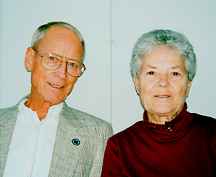
Burl and Martha Gilliland, 2003
|
|
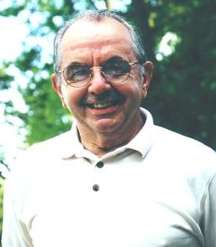
George
Osepchuk
|
 
Would
you believe GIs in drag entertaining the troops? Here's
George's story of a burlesque troop made up of GIs that
toured Korea right after WWII. Entertainment was rare but
these guys were popular. Don't miss George's story.
|
Click
here for
George's story
|
|
|
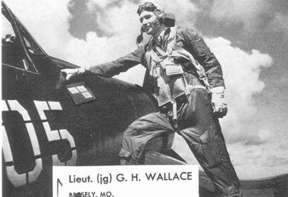
Navy publicity photo |
|
 Click
here for Glen's story Click
here for Glen's story
|
|
|
Special thanks to Sheila Davidson
who compiled and edited Glen's
notes and scanned his photos.
Tom Kercher - consulting and Image preparation.
Jack Henzie - consulting and final editing. |
|
|
|
Combat
in the air
Glen
Wallace's War Diary.
This is the actual combat
diary, with timely updates, of a Corsair/Hellcat pilot.
Glen takes us with him in the cockpit as he completes
training on Sable and Wolverine (side-wheel aircraft carriers),
fights in the Pacific, then returns home to "live
happily ever after" with his beloved Bonnie. Fly
with him on his first combat mission. Fly with him when
he enters, with some trepidation, enemy territory for
the first time. Fly with him as he participates in the
sinking of Yamato, the largest battleship ever. And, finally,
as he triumphantly flat-hats over a defeated Tokyo. What
a story; what a life! Don't miss this one!
|
|
 Dog
platoon at Driniumor river Dog
platoon at Driniumor river
Driniumor
River
If
you have read Paul
Tillery's story of the battle(s) at the Driniumor
River in New Guinea or Dr. Thomas Deas'
Last Full Measure, a tribute to a hero of the Driniumor
river battles, you may wonder about the place. Another
veteran of Driniumor has cleared it up. He was there in
a Dog Platoon and with his own sketches and photos makes
it clear what is was like. Bill's clear descriptions make
it very apparent how it was to be there.
Read his story
here.
Update on Teddy
2012
|
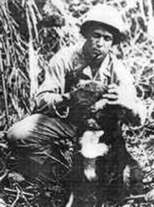
Cpl Bill Garbo and Teddy,
1945
|
Click
here for
Bill's story
|
|
|
|
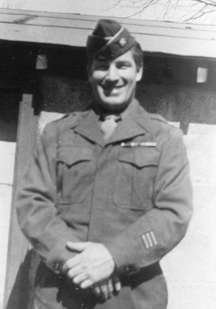
PFC Mario "Ben" Benedetto,
1945
|
Almost
forgotten episode in 1945
First American Troops
in Korea
The
first American troops in Korea were sent there in 1950 after
North Korea invaded. Right? WRONG! In an almost forgotten
incident, the 7th Infantry Division was sent there in 1945
to accept the surrender of the Japanese troops that had
brutally occupied Korea for years. They stayed to help South
Korea recover from the war.
Ben Benedetto was one
of those. Read his story here.
|
Click
here for
Ben's story
|
|
|
Site
Map What's
New Search
Send Corrections, additions, and input to:
WebMaster/Editor


|
