Reviews and Recommended Books
page 3

Recommended
Books about WWII and The Korean War
These
books are available at . . .
Amazon
and Barnes and Noble
and other outlets
At last we get a few laughs about WWII.
A Guest Review by Wallace
Wood
See Woody's other works . .
."The
Sergeant Who Captured A Division"
“Turbo”—the
Jet Engine’s Grand-daddy
The
Battle of Britain,
First
Salute to the Jet Age
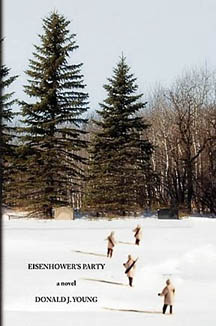
Eisenhower's Party
or Battle for Snow Mountain
by Don Young
It's a surprise to find a new book
about WWII we can enjoy without an upset stomach. If there is
anything funny about war, Don Young has a lot to tell us about
it with "Eisenhower's Party: A Double Mirror", a short
novel that "sort of" tells thestory behind the story
of the
Battle of the Bulge.
And more.If you have seen the war cartoons by Bill Mauldin,
you can appreciate the
Note!
This book has been reprinted under the new name: Battle
for Snow Mountain. See letter at 
adventures of GI's Richard and Timmons,
a grimy pair of foot sloggers like Mauldin's Willie and Joe characters
who are no heroes, but just grunts doing their job in a disaster.
Not since "Slaughterhouse Five" by Kurt Vonnegut, or
"Catch-22" by Joseph Heller has there been such a biting
satire of military operations that were so FUBAR (F…ked Up
Beyond All Recognition).
Don Young was there when it all began, he says, with the American's
under-trained, under-equipped, unready and badly led Lions Head
Division in 1944. The division was sitting right in the path of
the powerful German Volksgrenadiers sneaking up on them for a
surprise attack through the Ardennes Forest of captured Belgium.
An attack Eisenhower and others considered impossible.
"Unlucky" doesn't begin to cover their situation.
"We're sitting ducks," one GI sums it up accurately.
"He heard the sound of wishful thinking" all around
him, Young writes.
It took me awhile to catch on to the humor and irony of being
caught in a major attack of the war. But war is so awful that
all you can do is laugh as this hapless pair of Richard and Timmons
bumble and stumble their way into battle and captivity and then
out of it again. Once I did catch on, I couldn't stop laughing.
Richard is the Candide-like optimist, a self-styled poet and "Power
of Positive Thinking" dreamer, while death and destruction
rain down around him. He writes courtly love poems and letters
home to an earthy hometown gal who he has never even kissed. But
his fallen angel has kissed--and more than kissed-- just about
everyone else in the meantime.
His best buddy Timmons is the realist. Timmons idea of poetry
comes from reading the stalls of lavatories and his literature
is a cheap pornographic novel, Hungry Thighs. Richard carries
a picture of his soiled angel dear to his heart. Timmons carries
a memento, too-- a matchbox with soft tufts of short hair cut
from the nether regions of a girlfriend.
In a moment of great irony, Richard is forced to use his precious
picture as toilet paper.
Of course, Timmons gets the girls.
Real soldiers who know war will catch the many zingers of satire
on war books and movies that Young inserts as a veteran himself.
Every German outpost has a cabin conveniently available for reconnaissance
that the GI's can use. Every bombed town has a house with three
sides gone and the furniture still intact inside. Every letter
from home is filled with patriotic platitudes meant to buck up
the soldiers' spirits, but actually covering deep fears and personal
secrets that will become "Dear John" letters-or worse.
Every GI letter back to his family is filled with soothing lies
to smooth over amorous adventures and the real dangers, deprivation,
and horrors he faces.
Sophisticated readers will also notice an echo of Voltaire's classic
book, "Candide", in some of Richard's and Timmons' conversations.
"But Richard, how did we get into this mess?" (Timmons
asks)
"Well, we volunteered to come here. Others stayed at home,
claiming exemption for bad eyes or a heart murmur or because they
peed in their beds. At least we showed some hair in agreeing to
serve."
"But we came with a totally fucked-up outfit. We got a captain
who was afraid of his own shadow."
"In peacetime, good men never joined the army. So we ended
up with officers like (Captain) Plankton."
"That doesn't help us much."
"It should help you understand what happened."
"None of our officers knew what was going on at the front.
And we had no artillery--the ammo never arrived."
"Things like that happen in wartime."
"And we ended up in a crossfire, shooting at our own guys."
"That's because of the snow and fog. They couldn't see us
and we couldn't see them."
"There you go--- trying to make sense out of it. Our division
was defeated, wiped out in a few weeks…Richard, why can't
you see how ridiculous everything is?"
There is a once-famous picture of Eisenhower's Jeep leading a
parade into Paris on its liberation day. Guess who is the uninvited
GI shown riding on the fender on Ike's Jeep? -according to Don
Young. It was Eisenhower's Party, and Richard and Timmons were
there.
Highly recommended for a good laugh if you can see through the
dirt smudges and grimy faces of war.
Young's more serious book on the Battle of the Bulge is titled,
"The Lion's Share"
This is a fast paced spy
story
A Guest review by J. J.
Proctor
The
Tangier Option:
U.S. Navy and OSS Operation Torch
by Harold
(Hal) Malt
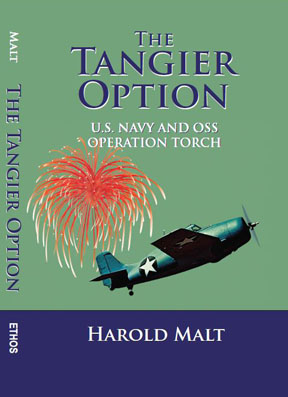
The Tangier Option: U.S. Navy
and OSS Operation Torch by Harold (Hal) Malt, Ethos Publish
(copyright) 2009, pp. 213 with two maps and Appendix. Price
$19.95.
This is a fast paced spy story about a washed out navy pilot
and a beautiful consulate Code Analyst in W.W. II Tangier, Morocco
who are assigned counter-intelligence roles when
Roosevelt and Churchill
decide to invade North Africa. As the allied fleets set sail,
it was critical that Hitler, his SS agents and his submarine commanders
be misled as to the exact place and date of the forthcoming invasion.
The story develops from dangerous missions by J.J. Jernigan and
April Kearfoot, interwoven with subplots of intrigue and characters
of conflicting loyalties: the French, Spanish, German and Rif
mountain Berbers. In a thrilling climax of aerial combat the Navy
pilot redeems himself and successfully thwarts Hitler's desperate
attempt to forestall the allied invasion.
Harold Malt, author and W.W. II Army Air Corps pilot, was able
to research secret archives in the American Legation library in
Tangier. There he uncovered hand written notes describing OSS
(later CIA) operational events. These accounts provide credibility
as well as operational and technical detail to the story.
A
Well documented story of the Cold War
Spies
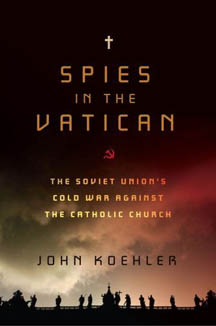
In The Vatican
By John Koehler
Recently I had a
talk with a young Russian man. He was here in a work exchange
program on the beach. He asked about the many war relics on
at Fort Pickens. He was interested and knew a lot about WWII.
He corrected me on the turning point of the war in Europe being
Stalingrad. It is no longer Stalingrad but he knew all about
it.
I am of the generation that was taught to
hide under the desks at school when the Russians were bombing
so I asked about the Cold War. He knew little about it as would
an American youngster his age. This book is an amazing account
of part of that war and how intense it was. It is a very well
footnoted account of the Soviet's infiltration of the Pope's
inner sanctum.
The author, John Koehler, was a former U.S. Army Intelligence
Offer specializing in counter-espionage and intelligence collection,
and an advisor to President Reagan as well as journalist for
almost 40 years. As I have said about other contributors, he
was there!
This is a must read for anyone who wants the real scoop about
the Cold War and maybe required reading for those who claim
to teach history.
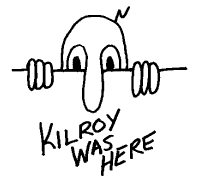
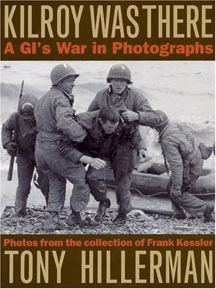
Kilroy Was There: A GI's War
in Photographs
by Tony Hillerman. Photos by Frank Kessler
This book is a treasure
of grey scale WWII photographs from the European theater in
WWII. As you will see these photos were taken by a combat photographer
who was there! They remained in his attic long after he died
until his brother found them. When one of my favorite writers
found these treasures, he published them with his narrative
based on the original captions. This is a book to keep!
Now, if I may be allowed a little self-congratulation,
note on several pages throughout the book my registered copyrighted
version of the graffiti appears. I'm not pointing out the registered
copyright to attempt to stop it's use but to establish authorship.
I, with my own two hands (after much research) drew this version
in 1997. It has been registered since 1998.
Don't get me wrong,
I have granted permission to any and everyone who asked. I am
just so proud that my version of the millions has become the worldwide
accepted version. Click the star for more information about the
image. 
An F-35 in the hands of a home grown
terrorist
The Pact
By Charles D. Richardson
I hate to use tired old cliches and name dropping but this book
almost earns them all. It is a good read, a page turner and
a thriller. In the style of Michener Charles Richardson goes
back several generations (1780) to build complete familiarity
with
one leading character and
his motivations. The jacket doesn't tell us about Richardson but
he must have experience in military aviation or he is a researcher
on the level Tom Clancy. His accurate descriptions are that good.
I usually keep notes on a little tape recorder
as I'm reading a book I plan to review but this time . . . I
forgot. The book is that good. There is little in the way of
a love interest but lots of action and you feel as if you understand
the workings of the F-35, aircraft carriers and even the pentagon.
The Missing Bomb
by Harry Rubin
The military has code words for mishaps that
involve nuclear weapons. The most serious are those in which
a weapon is lost or there is an area contaminated with radioactivity.
They called them "Broken Arrow." A real Broken Arrow
occured in 1958 when a Mark 15 nuclear bomb was really lost
in Wassaw Sound near Savannah, Georgia. This weapon used at
Hiroshima was a "mere" 15 kiloton fission bomb. The
Mark-15 had a yield of 1.6 to 3.9 Megatons! It has never been
found. For the true story, click HERE.
But what if an enemy of the US wanted to find
it to learn how to make one themselves? Harry Rubin weaves an
interesting novel based on this true story of a Broken Arrow.
Harry tells a very detailed account of another search for the
lost H-bomb -- before an unknown enemy is able to find it.
A
Novel of Intrigue and revolution
Civil
War II
Nelson O. Otttenhausen
WOW, what a timely book. It was first published
in 2004 but could have been written today after watching the
news. With fierce partisanship roaring on all sides and rhetoric
getting worse by the day and a collapsing economy along with,
some say, Socialist "bail outs" it is scary. Do you
ever wonder where this is all going? Well, Nelson Ottenhausen
tells us a possibility in a gripping tale of intrigue and revolution
. . . like any good story teller, he makes it sound very possible.
OK, OK, his stereotypical treatments of
Southern law enforcement and Southern wardens (not to mention
Southern names) only prove that he was not privileged to be
raised in the
South
. . . shades of Cool Hand Luke - "What we've got here is
(a) failure to communicate." I am also a little concerned
about the leading lady's ethics concerning privileged information
but I can easily forgive these transgressions because the book
was so darn readable.
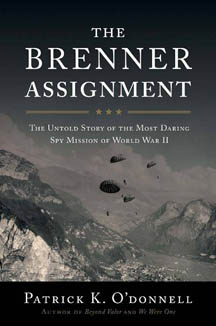
The Brenner Assignment
by Patrick K. O'Donnell
The Brenner Pass through the Alps between
Italy and Austria has been a route of conquest and commerce
since before the Romans. The last combat took place there in
the 1940s when Germany, the Allies (US OSS), and the Italian
partisans (the communist Garibaldi Brigades, Giustizia e Libertà
Brigades, and socialist Matteotti Brigades) fought the last
year of WWII. They fought to stop supply to the Nazis, to cut
off the retreat from the Nazis and to start the civil war in
Italy.
This is the untold story of brutality, intrigue,
combat, and even a little romance. You'll like it. I did!
A Historical
Novel
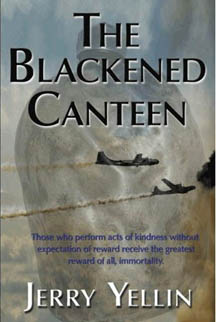
The Blackened Canteen
By Jerry Yellin
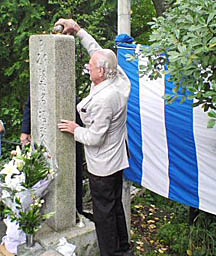
Image courtesy http://39th.org
Jerry Yellin pouring Kentucky bourbon over shrine dedicated
to Japanese and American dead - on Mt. Shizubata
Jerry Yellin
is an amazing talent! At his age he should have many books on
best seller lists. I submit that he would have if it were not
for a minor little distraction -- WWII. Then, like the rest of
his generation, he returned to lead a second-tier nation barely
out of the depression and into the country we know today.
The book is at once a novelized history of
WWII in the Pacific, a love story, and a poignant story of humanity
in a world gone mad. Jerry has a gift for detail that is amazing.
I felt as if I were actually in the nose of a B-29 – and
I have actually been in the nose of a B-29! Jerry's description
is better.
His narratives are about some participants
in WWII both major and minor, American and Japanese. And they
are sharp and clear. We get an intimate picture of Japanese
and American individuals as they experience the war beginning
with the depression for the Americans and the war in China for
the Japanese.
I have already purchased another copy to send
to a Japanese friend in Japan. This is a wonderful book and
a must read, not just for WWII students but for everyone who
enjoys a wonderful story well told.
Pensacola 04/21/2015
NOTE: Jerry is still at it! The following is a quote from
Doctor K. Inge Holman — a retired physician and also
a superb pilot:
"This fellow is part of the greatest generation leaving
us. Wonderful interview. A class act regardless of age.
Well worth the time to watch. One of the few WWII vets
left. When you listen to what he says, you will understand
why you are proud to be an American.
They simply don't make 'em like this any more. Take five
minutes watch this video interview -- and listen carefully
to what he says and how he says it. I promise you, you
won't regret a second of it.
Ask yourself, how many of the few surviving WWII veterans
kept themselves and their uniform in such good condition
for over 70 years and can still proudly wear it?
Notice his superb delivery, no teleprompter, no script
-- just a
91-year-old fighter pilot representing the greatest generation
at home and
abroad who won WWII. He has some surprises and a great
take on the
philosophy of life."
Click
here to watch the video on dvids Defense Video & Imagery
Distribution System)
A
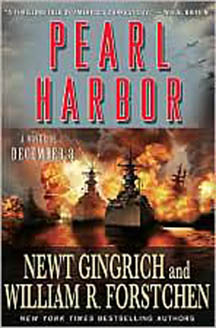
Novel of December 8th
Pearl Harbor
Newt Gingrich and William R. Forstchen
This a great book, an absolute page turner!
I don't usually read historic fiction because, frankly, I'm
afraid I will confuse fiction with fact. I might pontificate
solemnly someday about something that
happened only to find I mixed it up in my head with fiction.
I made an exception for this book because I am such a fan of
Newt Gingrich both as a scholar/historian and politically.
This book is fiction but there is so much truth that it all
flows smoothly together. It tells the story of "America's
darkest day" by following heros from both sides . . . thus
the title including December 8th which is the "Day of Infamy"
in Japan.
The Few
by Alex Kershaw
During the Viet Nam war when Canadians were
welcoming American draft dodgers and deserters, I wrote that
there was another time when young American men broke American
law and were welcomed by the Canadians. Only then it was Americans
going to Canada to join the RCAF or a few who continued to England
to join the RAF and fight the Battle of Britain. This is the
story of that few . . . and what a story it is. Alex Kershaw
brings it to life with an up close and personal view of their
lives as well as the
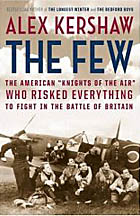
lives of the other young pilots in Spitfires
and Hurricanes plus the German view of the battle from Me-109s
and 110s.
Excellent and detailed descriptions of dogfights seem like fiction
until you check the footnotes and find that they are taken from
many actual individual combat reports. An excellent book and
well worth the read! Alex Kershaw also wrote The
Bedford Boys.
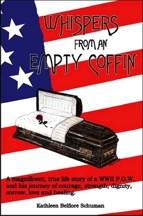
Whispers from an Empty
Coffin
So real, unpretentious, and down
to earth that you feel
you are there and a member of the family.
By Kathleen Belfiore Schuman
This book is first a tribute to an American
WWII hero. It then abruptly switches to a detective story as
the author searches for the hero's grave. The author's description
of the search is so real, unpretentious, and down to earth that
you feel you are there and a member of the family. Kathleen
Belfiore Schuman talks to the reader as if she were standing
in the room with him.
The book is very well documented. She includes
actual scans of the original documents including the terrible
telegram telling the family of the loss off their son. There
is so much in the way of scans and/or verbatim transcripts that
it would make a good reference book if only there were an index.
A family history is hard to write in such
a way that it is interesting to outsiders but she pulled it
off.
Thank you Kathleen for letting us share
this story.
For more info see
On
Man' Courage!
Twi-light
Reminiscences from WWII
Fading Warriors
The Hitler Book, The secret dossier prepared for Stalin. Edited
by Henrik and Lee Estes, FPSA
As you might expect,
I thoroughly enjoyed Fading Warriors, Candid Memories From World
War II! The author, Lee Estes (a WWII hero himself) set out with
the same goal as www.KilroyWasHere.org.
That is to tell the stories - or rather let the individual themselves
tell their stories of WWII. And what stories they are! Every one
is a thriller and every one is worth the read. I am reminded of
a quote by Christopher J. Anderson, Editor, World War II magazine:
"For those of us who are fascinated by the events of 60
years ago, there is no better way of understanding what happened
than by listening to an eye witness."
This book will give you a better understanding of what happened!
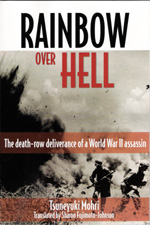
Rainbow over Hell
The death-row
deliverance of a World War II assassin
I
heartily recommend this book to anyone but especially to those
Marines who fought on Saipan. At last, a human face on the fierce
enemy.
By Tsuneyuki
Mohri
Translated by Sharon Fujimoto-Johnson
What a great book! This is the story of
Saburu Arakaki an 18-year-old caught in the battle for Saipan.
Afterwards he was sentenced to death for assassinating two prisoners
for collaboration with Americans. His death sentence was changed
on review from Washington, but his life was inexorably changed.
He was finally released only after he had found God and was
to became a Seventh Day Adventist pastor. It is a story of terror,
horror, defiance, courage, betrayal, despair and finally redemption
and absolution. I heartily recommend this book to anyone but
especially to those Marines who fought on Saipan. At last, a
human face on the fierce enemy. I hope Sharon Fujimoto-Johnson
brings us more like this!
Originally published in 1998 in Japanese as Jigoku-no Niji,
it is a gripping read and well written. The translation must
have been difficult, but Sharon Fujimoto-Johnson managed to
retain the emotion, excitement and one of the best personal
descriptions of warfare I have seen. You can almost feel Saburo's
terror as he saw the American armada offshore. It is strange
for me to feel terror of Americans especially knowing from Marine
accounts that those boys heading in on the landing craft were
just as terrified. Finally, the close and intimate telling of
his discovery of Christianity is inspiring!
As a personal aside, it is enlightening to read of this famous
battle from the Japanese side. I have long been fascinated by
that last great banzai charge on Saipan. Banzai charges served
the Japanese army well in China as it did western armies through
WWI but against Marine firepower they turned out to be slaughters.
They continued as a Japanese tactical measure until Saipan.
At Iwo Jima and Okinawa they were dropped in favor of a defense
in depth that proved much better from the Japanese viewpoint
and much much worse for the Americans. This story about Japanese
youth on Saipan mentions the banzai charge only in passing but
brings new light to it. In this case, the banzai charge here
was less a tactic that a sad, desperate last attempt to die
for the emperor and some four thousand were successful.
This
book available at Amazon, N&N and at http://rainbowoverhell.com
And another review from a reader who has
read both the Japanese and English versions.
Rainbow
Over Hell is the true story of a young civilian named Saburo
Arakaki who stood on Suicide Cliff during the Battle of Saipan
and who, against all odds, survived one of the bloodiest battles
in the Pacific War. He was one of the men in Captain Oba's
Company, the historic final group of Japanese stragglers to
surrender on Saipan nearly a year after the island had been
secured by American forces. Arakaki also has the distinction
of being sentenced to death for assassinating two Japanese
men who were cooperating with the Americans. When he discovered
that Jojima, the MP who had given him the assassination order,
had betrayed him and gone home to Japan as a free man, leaving
him to die alone, he vowed to himself that, if he were ever
released, he would find the man and kill him. Because of a
healing and transforming encounter with the Bible while imprisoned
in Hawaii, however, he was so transformed from a hatred-filled,
angry man into a peaceful, compassionate man that his own
warden petitioned for his release. He was granted full pardon
by President Eisenhower. Once released, Arakaki promptly made
business of visiting the man whom he had once vowed to kill.
Would he be able to forgive his Judas? How would Jojima react
to his sudden appearance?
Once
a murderer, now a minister of Gospel, Arakaki has been telling
his life story whenever and wherever he has a chance, for
more than forty years now. In Japan, in Korea, in America
and Canada, he preaches about the miracle that had taken place
in his life. And no matter how many times one hears him tell
the story, he/she is moved. The man's passion and enthusiasm,
after so many decades, has not diminished one bit. He is still
awed and thrilled by the way that God has changed his life,
and it is impossible to leave his presence without being touched.
This
same story of great deliverance and redemption is now told
by award-winning writer Tsuneyuki Mohri. An accomplished storyteller,
he draws you like magic into the depths of young Arakaki's
innermost battles. This is not a "based on a true story"
novel. It is a true story. The author rigorously follows the
truth and facts without embellishing anything. One can tell
that a great deal of research was done; the details of the
war, the conditions of the detention camps, how the stragglers
were cornered from one end to the other of the tiny island,
are painfully vivid and real. Those who are interested in
what it was like on the Japan side during the WWII, this book
is a "must" read.
Written
in documentary style, the story begins with the scene in which
Miike (the name Mohri uses for himself in the story) and Pastor
Arakaki flying to Saipan from Fukuoka, Japan. They are on
a tight-schedule to retrace what had happened decades ago
in Arakaki's life. The story, then, moves to Arakaki's poverty-stricken
childhood. Alternately and freely, going back and forth in
time, the author takes us on a journey of Arakaki's life and
of the trip that they're currently taking.
Reader
friendly, for both young and old, for both Christian and non-Christian,
it's a real page-turner. Once one starts reading it, one cannot
put it down. The Japanese language is considered one of the
hardest languages to translate into Western languages, but
Sharon Fujimoto-Johnson skillfully achieves the task, without
failing to preserve Mohri's charismatic writing. The reader
will cry, laugh, rejoice as the boy Arakaki goes through life's
trials. But that's not all. Do not miss the writer's postscripts
which are just as powerful. One will come to realize that
this book was not written by chance, but by the guidance of
a Superior Power. It is a one-of-a-kind story, which no one
should miss.
Yoshika Caraig, April, 2006
Yoshika Caraig: Musician/artist.
Born in Japan, now resides in NY with her husband and 3 naughty
dogs.
http://www.geocities.com/yoshika_recreation_cd/
The Jedburghs
The
Jedburghs
by Will Irwin
Ever Wondered
where the French Resistance in WWII got their name of Machi? Well, this is the
book for you. You will also find out how the Jedburghs got their name and how
the Allies supplied and supported resistance forces from Belgium and France and,
after the fall of Germany, to Asia a well to help defeat the Japanese. The Jeds
parachuted behind
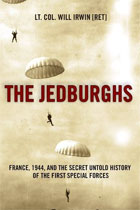
enemy lines and supplied resistance
forces with arms and assistance. What a story! This was the beginning of Special
Forces. See how it all began in spite of it being "ungentlemanly"according
to the Allied pre-war General Staffs.
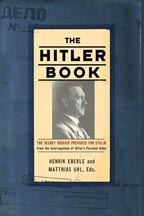
The secret dossier prepared
for Stalin
The Hitler
Book
The Hitler Book, The secret dossier prepared for Stalin. Edited
by Henrik and Edited by Henrik and Mathias UHL
The Hitler Book was written for Stalin by two security service officers of the
NKVD/MVD, There was, admittedly an agenda. "They wanted to brand Fascist
leaders as licentious . . ." and a "tool of German Capitalism,"
They also worked under heavy pressure to prove that Hitler was either alive and
had escaped to South America or was, as Stalin believed, a coward who took poison
instead of shooting himself. Most of
the
details came from Otto Guensche, Hitler's adjutant, and Heinz Linge, his personal
valet. Both were captured by the Russian Army in Berlin. The Hitler Book was finally
given to Stalin in 1949, it was then hidden away for decades. Not until 1991 was
it found by Matthias Uhl and its validity confirmed
In spite of the agenda
and USSR politics, this book is probably the most accurate, intimate and authoritative
publication about the last days of Hitler. It is a must read for WWII scholars,
WWII history buffs and anyone who is interested in Stalin or Hitler because it
tells us a lot about both men.
Fascinating stories
from 12000 years ago to modern times
Mysterious Florida
By Bill Hanson
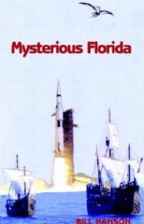
Do you
love mysteries? I do! I don't mean "Who done it's" but mysteries like
the Bermuda Triangle, The
Lost Patrol, Spontaneous human combustion, the Winchester home and others.
These intriguing stories, done right, are fascinating . . . Hanson's are done
right. Unlike most, however, these mysteries include some from modern times, including
WWII, Flight
19, and the Nazi's efforts to build an atom bomb. .
I have lived in
and loved Florida for many years but have never known it like I do now. I was
even lucky enough to see the old "Hotel Notorious" as Bill Hanson puts
it, where the movie Key Largo was filmed; but that's all I knew until I read this
book. There is a whole lot more to that story than a movie filming. This is a
good read!
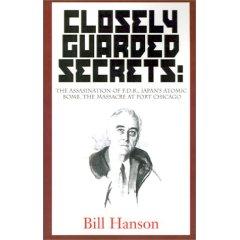
Closely Guarded Secrets:
The
assassination of F.D.R., Japan's Atomic Bomb,
The Massacre at Port Chicago.
A fun and intriguing read
By
Bill Hanson
OK,
kick back, relax and prepare for a good light read. As with any conspiracy theory
worth the name, it has lots of facts that you knew already. More that sound like
they could be true and some conclusions that just could be true based on these
facts. This one is well done and starts with some great history on Nazi operations
in the US before and during WWII. There is definitely enough there to get you
to thinking!
As a bonus, he fleshes out the rumors of a Japanese A-bomb
that was tested within months of ours and of some more on the well-known explosion
of two cargo ships in Chicago in 1944.
All three stories are fascinating
and well worth the read!
Shooter
By
Gunnery Sgt. Jack Coughlin, USMC
Captain Casey Kuhlman, USMC
Donald A.
Davis
St. Martin's Press 2005
Gone is the AW shucks shyness of WWI heroes and the "the
real heroes are still there" modesty of WWII and Korean war heroes. Instead
the Marine snipers in Shooter have all the braggadocio and bluster of fighter
pilots but fighter pilots set out just to kill another airplane. They are almost
surprised when they discover a real live person's face in the cockpit looking
back at them. Snipers really earn their braggadocio because their kills are up
close and personal. Even at 800 yards, with those scopes, they see clearly the
person they are killing.
Snipers traditionally have fallen out of favor
with the US military between wars because it was considered vaguely unsporting
or unfair to pop an unsuspecting target a half mile behind their lines. But during
every American war, snipers have been brought back because they are so damn effective.
They are effective not just in the number of kills but psychologically too. Is
there no place safe? Fact is, in the kind of war we have now, there is no safe
place FOR ANYONE. You might get it from a homicide bomber in Cleveland and a terrorist
in Iraqi might get it wandering alone a half mile away from the front.
I
couldn't put down this book! This book gives a rare close up look at our tough,
volunteer, military. A military that is made up of professional killers. The author
really tries to be super tough and make it clear he is good at and enjoys his
work . . . but, in spite of him and in spite of his best efforts some mushy humanity
slips comes through when telling about the one who got away or the animals caught
in the crossfire locked in a corral or in his last chapter.
I
like and respect this guy! Not only because I like and respect every Marine but
because he is so damn good at his job. This book is a must-read! Semper Fi!
unless
you love America bashing
SKIP
Flyboys by James Bradley
I
am getting very weary of writers and journalists using any excuse to criticize
America and America's history. True, there were some awful things that happened
as Europeans moved west but that is the same story of agrarian cultures displacing
hunters-gatherers and nomads since Neanderthal. There were always nomadic cultures
that had the same thing in common, great battlefield heroics, and terrible treatment
of their
women and captives.
They were invariably pushed aside by plodding farmers accompanied by multitudes
and civilization. Some historians cherry pick the history that proves their preconceived
point . . . in this case, how terrible 19th century Americans were, ignoring the
other worse horrors taking place throughout the world; the Napoleonic wars, 1,000,000
deaths by Shaka's wars<1>. More than two million black slaves shipped to
Islam<2> (while Americans were fighting the bloodiest war in our history
to free ours), Thailand's extermination of the indigenous pygmies on the Malay
peninsula, Thugees in India, Pogroms in Russia, British, French, Russian, Ottoman,
empires flourishing with more brutal tactics and less excuse. Bradley's apparent
intent is to prove that 19th century Americans were the worse.
He even
plays the always useful race card implying that it was racism that made Europeans
move west across a continent. He actually seems to compare the alleged American
"ethnic cleansing" of the west with the Japanese in China in the 30s
quickly, skipping over the Rape
of Nanking! He caps the America bashing by joining the Smithsonian theme that
the entire Pacific war was a result of American racism.
Someday
historians will cherry pick through the history of our current times. With little
effort they can pick antiwar historians and prove that America started an illegal
war, brutalized prisoners and murdered thousands of civilians. Or pick different
ones that prove that America defended herself against an implacable cruel enemy
humanely and, in the process, freed millions of oppressed people. Which one you
"prove" depends upon your predisposition. In this case, Bradley's predisposition
seems to be trash American history up to Pearl Harbor. I don't know what he says
after that because I stopped reading his book after his trashing our history through
the Philippine War.
Why does Bradley need to throw in
hot-button words like "ethnic cleansing," "conquest," or "extermination"
when referring to America's move west, the Mexican American War (Mexicans good
- Americans bad) and the Philippine War (1899-1902.) Is it that he is the product
of modern American schools or just to give him perceived stature among his peers?
Does it make an author feel somehow more intellectual to bad-mouth the country
of his birth that has given him so much?!
I loved his first
book (Flags of Our Fathers) where he stuck to the subject of his father's heroic
history and left the bad-mouthing to Jane Fonda and Michael Moore. Flyby this
one, at least flyby chapters one through seven - these chapters ruined the book
for me. I had to stop there. In short, skip this book unless you love America
bashing.
<1> Terror and Resistance, Eugene Walter
(1969)
<2> Islam's Black Slaves, Ronald Segal
Click the image for a larger view
The Fighting First
The
Untold Story of the Big Red One on D-Day
by
Flint Whitlock
This
is "The Untold Story of the Big Red One on D-Day" but so much more!
This Big Red One story begins in North Africa and the Kasserine Pass where "The
first Division stopped the famous 10th Panzer cold in two attacks." It goes
on to Sicily where with Patton where they "suffered greatly." You'd
think they had earned a rest but the only rest they got was back in England preparing
for Omaha Beach. While there, Whitlock gives the reader some real insights into
life for Americans in wartime England. From there,
it's on to Omaha Beach and Rommel's Atlantic Wall. Whitlock gives a lot of details
of loading landing craft and of the actual landing where it was said by Corporal
Michael Kurtz as reported in The Longest Day: "I want all of you Joes to
keep your heads down. As soon as we are spotted, we'll catch enemy fire. If you
make it, OK. If you don't, it's a hell of a good place to die. Now, let's go."
Whitlock also tells of serious errors in the preparation of the Omaha beaches
that led to this understated comment: "The beach area of Omaha Beach was
almost unscarred. We did not have a single one of those gun emplacements or pillboxes
knocked out. Not a good situation.
"Now, have they
earned a break? No way. They are finally pulled off the line in December, 1944.
Guess what was about to happen the morning of 16 December - The Battle of the
Bulge! The Big Red One is called upon again!
I have
often been asked why WWII GIs have waited to talk about their experiences till
now and Korean War vets still aren't talking. Perhaps, Whitlock says it best:
"Only with other veterans would a soldier speak of the unspeakable for only
other veterans would know of the hardships, fear and tragedy, and, yes, even the
exultation of combat."
This is one hellava book!
Don't miss it.
The
Bedford Boys
One American town's Ultimate
D-Day Sacrifice
by Alex Kershaw
Click the image for a larger view
The Bedford Boys, One
American town's Ultimate D-Day Sacrifice
by Alex Kershaw, Da Capo Press,
2003 Twenty-two young men, all from a small town in Virginia, made the ultimate
sacrifice. Nineteen died during the first wave on Omaha Beach; later, three more
died in the campaign that followed. This is their story - theirs and the other
young men from Bedford. It is also the story of the people they left behind and
the country they were fighting for.
This book is sad but inspiring and informative.
You will follow these youngsters from a small- town childhood through the tragedy
of Operation Tiger to the fierce brutality of Normandy, June 6, 1944. You will
find out more than you ever really wanted to know about why you chose the top
of six bunks on the Queen Mary (converted to a troop ship) instead of the more
convenient lower ones. You will learn, perhaps with some comfort considering today's
news, that the country was not totally united during WWII, in spite of what we
are now believe. John L. Lewis conducted his strikes, and there were race riots
in Los Angeles and Detroit.
This book inspired Saving Private Ryan . . .
as it will inspire you.
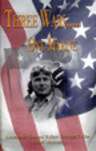
Click image for a larger view
Three Wars.....One Marine
by
Lieutenant General Robert Prescott Keller USMC (Retired),
Trents Prints,
2003
What a life! This is an amazing
story of a youngster that starts with his running into the on-stage arms of Al
Jolson and continues with rubbing elbows with the likes of Charles Lindberg, Chiang
Kai Shek, John Glenn and others. It is absolutely fascinating what this man experienced.
He began his military career as a Private (became a PFC the same day) and
finished
a Lt. General*. In flight school, he casually
writes of riding a train or car across the country in a time when most Americans
never traveled more than 30 miles from home. He goes on to dealing with the Communist
Chinese in China after WWII.
Of course,
I was most interested in the WWII and Korean war tales, but there is something
here for every history buff including Viet Nam. It's an all around good read and
well worth the time!
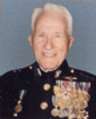
Lt General Keller
This
book is only available through The Publisher, Trent's Prints, 3754 N. Willard
Road, Pace, FL 32571. Tel. No. 1-866-275-7124. Cost $18.00, plus $2.50 handling
and postage. E-mail Terry@TrentsPrints.com
*
This is a three-star General, just one rank below a four-star general - the highest
anyone can expect to go in the military. The five-star general rank was created
during WW II because several American commanders found themselves commanding Allied
officers of higher rank. When General of the Army Omar N. Bradley died in1981,
the five-star ranking was no more. In all, four Army generals, four Navy admirals,
and one Air Force general held the rank. The Army's five-star generals were George
C. Marshall, Douglas MacArthur, Dwight D. Eisenhower, and Omar N. Bradley. The
Navy's five-star fleet admirals were William D. Leahy, Ernest J. King, Chester
Nimitz, and William F. "Bull" Halsey. Henry Arnold was the Air Force's
only five-star general.
D-Day 1944
Voices from Normandy
by
Robin H. Neillands and Roderick de Normann, Cold Spring Press, 2004
This
book may very well become the definitive book on D-Day, at least from the British
viewpoint. It is very detailed, reminiscent of Churchill's The Second World War
or Morison's 15 volume History of United States Naval Operations in World War
II. Groups are named, often down to the squad level and personal stories from
named individuals (British, American and German) are smoothly woven into the story.
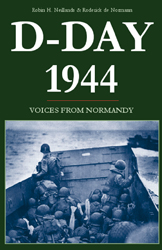
This book starts with an excellent
chapter, Dunkirk to D-Day 1940-1944, that in very few words brings you up to date
including even a defense of the ill-fated raid on Dieppe, in that it taught the
basic lessons on how to operate on D-day, indeed amphibious warfare throughout
the war.
All in all, this is an excellent book on D-day–a
little too heavy and detailed, perhaps, for the average, casual reader but for
historians, researchers, and avid WWII "junkies" such as those who read
Kilroy Was Here, it can't be beaten!
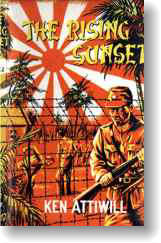
Three Books from the War Years! Long out of print
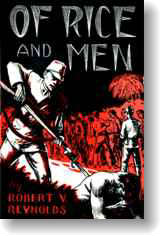
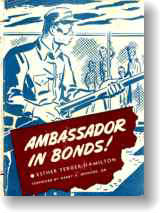
''The story is simply and modestly told, and
for that reason gains greater dramatic effect than if Reynolds had set himself
up as a hero or sounded off on the 'lessons' of the war and what-to-do-with-Japan.
''The impression you get is that he went
through hell gracefully, survived his sufferings by a combination of luck and
moral and physical stamina.
''The narrative
begins with the last ditch fighting at Bataan and goes on to the frightful death
march, the various prison camps where death and foulness were gruesomely commingled,
and two months' voyage on a Jap 'hell ship' and finally a term as slave laborer
in Japan.
''The happy ending comes when the
emaciated Reynolds, who had missed death by inches countless times, sees a giant
B-29 fly over the POW camp after the surrender, and drop food supplies."
''
Minneapolis Star Journal Reviews from the book jackets.
by Robert V. Reynolds, The Leicht Press, 1951
"Esther
Yerger Hamilton has given. us a vivid account of the war in the Far East of the
ruthlessness of the Japanese warriors; of the privation, suffering, sorrow, bravery,
and faith of our missionaries who were interned in the Philippines: and of their
thrilling and swift liberation by American troops. Above all these things, however,
standing out like a beacon light in the darkness of the night, is seen the faithfulness
of God to His own amid terror, danger, and death. The war is brought right into
the homes of people we know in this historical tale.
The
book is not without its romantic appeal. In fact, the devotion of John Hamilton
and Esther Yerger, their trust in God and confidence in each other, and their
reunion and marriage after eight years of waiting and five years of forced separation
are as strange as fiction, and will play on the heart-strings of all, satisfying
the most sentimental of readers.
BONDS is
an engaging story full of adventure and love, but a story which is fact and not
fable. "
E. Schuyler English, Litt.D
....Reviews from the book jackets. by
Esther Yerger Hamilton. Pinebrook Book Club, 1946
"Two thousand Emaciated British
prisoners-of-war, packed like sardines on wooden shelves in the gloomy holds of
a small tramp steamer battling up the China Seas; no medicines provided, dysentery
raging; one in every four was destined to die, while the rest went to slavery
for the next three years in the coal mines of Honshu and Kyushu. This is the theme
of one of the grimmest yet most human stories in the whole literature of World
War II. It is told for the first time in this compelling book, taken direct from
a factual diary kept throughout 3 ½ years imprisonment in Java and Japan.
It is a complete and vivid record of a long, terrible experience - yet gripping
as any imagined adventure story.
They
never lost faith that another day would come, and come, and it did. Ken Attiwill
faithfully records ever changing phase of it. The tide of war turned, engulfing
an arrogant nation suddenly bewildered. He heard the devastating explosion of
The Bomb That Stopped The War . . . and saw Nagasaki swirl up in atomic dust.
He saw the Japs in tears over the shame of surrender, the poor puzzled women raking
their ashes for food; and then, when P.0.W. relief supplies were air-dropped,
the half starved prisoners forgiving their tormentors, sharing their manna from
heaven.
Here
is a tremendously encouraging Story for those who believe ill life and have faith
in its good purpose"
..........................Reviews
from the book jackets, by Ken Attiwill, Robert Hale LTD, London 1957
These
are three books I discovered. I thought you and or the Kilroy readers might find
them interesting. The books are all true accounts of brutal imprisonment by the
Japanese. They are dated 1946, 1949, and 1957.
It is often said that racism played a significant role in the conflict between
Japan and the Allies during World War II. The Japanese hated the colonialism of
the whites in what they considered their sphere of influence. We in turn had nothing
but loathing for the Japanese following Pearl Harbor. Also, there is much written
about the use of propaganda, the vilification of the enemy, and the use of negative
characterization in media. These covers may reflect some of this, but after reading
many books such as these, I imagine that those thousands who suffered and died
in Japanese prison and slave camps would find these images fairly accurate.
Bob
Cook
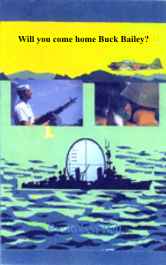 Will
you come home Buck Bailey?
Will
you come home Buck Bailey?
By Robert
J. Bell
This
is the wonderful story of a high-spirited youth's adventures through WWII. Like
the fun loving youngster he was, the story is mostly fun reading but turns to
grim sadness in the excellently crafted combat narratives. The story takes you
from Buck as a youth in prewar America with an hilarious missed Love-life opportunity
to a seasoned warrior forcible relieving the Officer of the Day on his own bridge
when he didn't follow the Admiral's orders.
The
early part is a matter-of-fact telling of a different America where his grandfather
had to sell pencils to live and a youngster who split his meager pay to send to
his grandmother. His war starts in the Mediterranean with landings in North Africa
and Salerno. You later experience with Buck the Battle
of Leyte Gulf with its Kamikazes and sail into Tokyo Bay, all the while getting
into regular trouble because Buck loves his shore time. What a story!
The
Aviation Photography of
PHILIP MAKANNA
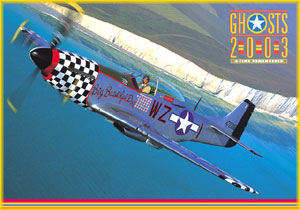
I don't usually review
publications other than books but my new Ghosts Calendar for 2003 just arrived.
To those who love old warbirds, this is a must! As you can see above, the cover
is a warbird lovers favorite, the Mustang! But it doesn't stop there. The photographs
are absolutely beautiful! January is a early Tuskekee Mustang (without a bubble
cockpit) flying formation with a YAK 3M. February is British Meteor, March, a
Spitfire, April, a B-25 but I won't give them all away -- look forward to each
month as I do.
Instead of listing Fathers Day or Flag Day, Phil puts
an excellent time line of WWII, historic aircraft events and aircraft specifications.
A must for us warbird nuts! See Phil the Ghost's web site at: www.Ghosts.com.

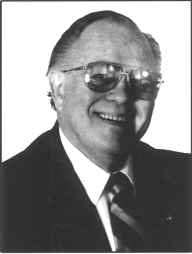
Richard Rohrbacher
Growing Up Before
the Bomb:
The
Innocent Years 1935-1945
by Richard W. Rohrbacher, Ph.D
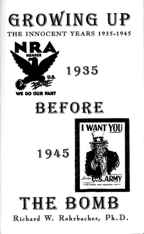
OK, who should
read and would enjoy this book? First, anyone from the "GI" generation
(Brokaw's The Greatest Generation) born 1901 -- 1924* or the "Silent Generation"
born 1925 -- 1942.* They can remember a time in America when a 10-year-old could
go out to play in the morning and his parents not worry about him unless he was
late for dinner. Those who remember can play "Nostalgics" (a word coined
by Shelley Berman) and relive those days. Boomer generation members, born 1943
-- 1960, will love it because it shows a time in America that they were born into
- but lost. Generation X, born 1961 -- 1981 can begin to understand that all those
wonderful stories the old man (their fathers and grandfathers) told are really
true. The Millennial Generation and beyond, born 1982 -* should read it so they
will listen with more attention to the old men. They can learn so much!
What
a story! Richard Rohrbacher starts it in 1935 and skillfully makes a youngster
spring to life before your eyes. From hanging around a construction site to the
first guilty feelings of an adolescent that can't help but fall in love (lust?)
with his 8th grade teacher. From the sad musings of old man about dying to the
youngster's hilarious fear of dying himself from an "advanced case of acutum
masturbatum morbindus," Richard keeps your face in his book.
The
narrative saddens, as did the whole world, as first, his love (the teacher) left
to join the WACs. Then his family, then his friends as ". . . we watched
the June graduates trade their gowns and mortarboard for uniforms." They
also ". . . wondered if our name was slated to appear on some future casualty
roster . . ."
This book captures, in an easy readable
way, life in America as the world skid inexorably into WWII.
*Generations,
by Neil Howe, William Strauss, William Morrow & Co.
These
books are available at . . .
Send Corrections, additions, and
input to:
Back to Miscellany, page 1


Visitors since
June 6,
2000

|
|
|
These
books are available at . . .
|
|
At last we get a few laughs about WWII. A Guest Review by Wallace
Wood Eisenhower's Party by Don Young It's a surprise to find a new book about WWII we can enjoy without an upset stomach. If there is anything funny about war, Don Young has a lot to tell us about it with "Eisenhower's Party: A Double Mirror", a short novel that "sort of" tells thestory behind the story of the |
||
Not since "Slaughterhouse Five" by Kurt Vonnegut, or "Catch-22" by Joseph Heller has there been such a biting satire of military operations that were so FUBAR (F…ked Up Beyond All Recognition). Don Young was there when it all began, he says, with the American's under-trained, under-equipped, unready and badly led Lions Head Division in 1944. The division was sitting right in the path of the powerful German Volksgrenadiers sneaking up on them for a surprise attack through the Ardennes Forest of captured Belgium. An attack Eisenhower and others considered impossible. "Unlucky" doesn't begin to cover their situation. "We're sitting ducks," one GI sums it up accurately. "He heard the sound of wishful thinking" all around him, Young writes. It took me awhile to catch on to the humor and irony of being caught in a major attack of the war. But war is so awful that all you can do is laugh as this hapless pair of Richard and Timmons bumble and stumble their way into battle and captivity and then out of it again. Once I did catch on, I couldn't stop laughing. Richard is the Candide-like optimist, a self-styled poet and "Power of Positive Thinking" dreamer, while death and destruction rain down around him. He writes courtly love poems and letters home to an earthy hometown gal who he has never even kissed. But his fallen angel has kissed--and more than kissed-- just about everyone else in the meantime. His best buddy Timmons is the realist. Timmons idea of poetry comes from reading the stalls of lavatories and his literature is a cheap pornographic novel, Hungry Thighs. Richard carries a picture of his soiled angel dear to his heart. Timmons carries a memento, too-- a matchbox with soft tufts of short hair cut from the nether regions of a girlfriend. In a moment of great irony, Richard is forced to use his precious picture as toilet paper. Of course, Timmons gets the girls. Real soldiers who know war will catch the many zingers of satire on war books and movies that Young inserts as a veteran himself. Every German outpost has a cabin conveniently available for reconnaissance that the GI's can use. Every bombed town has a house with three sides gone and the furniture still intact inside. Every letter from home is filled with patriotic platitudes meant to buck up the soldiers' spirits, but actually covering deep fears and personal secrets that will become "Dear John" letters-or worse. Every GI letter back to his family is filled with soothing lies to smooth over amorous adventures and the real dangers, deprivation, and horrors he faces. Sophisticated readers will also notice an echo of Voltaire's classic book, "Candide", in some of Richard's and Timmons' conversations. "But Richard, how did we get into this mess?" (Timmons asks) "Well, we volunteered to come here. Others stayed at home, claiming exemption for bad eyes or a heart murmur or because they peed in their beds. At least we showed some hair in agreeing to serve." "But we came with a totally fucked-up outfit. We got a captain who was afraid of his own shadow." "In peacetime, good men never joined the army. So we ended up with officers like (Captain) Plankton." "That doesn't help us much." "It should help you understand what happened." "None of our officers knew what was going on at the front. And we had no artillery--the ammo never arrived." "Things like that happen in wartime." "And we ended up in a crossfire, shooting at our own guys." "That's because of the snow and fog. They couldn't see us and we couldn't see them." "There you go--- trying to make sense out of it. Our division was defeated, wiped out in a few weeks…Richard, why can't you see how ridiculous everything is?" There is a once-famous picture of Eisenhower's Jeep leading a parade into Paris on its liberation day. Guess who is the uninvited GI shown riding on the fender on Ike's Jeep? -according to Don Young. It was Eisenhower's Party, and Richard and Timmons were there. Highly recommended for a good laugh if you can see through the dirt smudges and grimy faces of war. Young's more serious book on the Battle of the Bulge is titled, "The Lion's Share" |
|||
|
This is a fast paced spy story A Guest review by J. J. Proctor The
Tangier Option: by Harold (Hal) Malt The Tangier Option: U.S. Navy
and OSS Operation Torch by Harold (Hal) Malt, Ethos Publish
(copyright) 2009, pp. 213 with two maps and Appendix. Price
$19.95. |
|
| Roosevelt and Churchill
decide to invade North Africa. As the allied fleets set sail,
it was critical that Hitler, his SS agents and his submarine commanders
be misled as to the exact place and date of the forthcoming invasion. The story develops from dangerous missions by J.J. Jernigan and April Kearfoot, interwoven with subplots of intrigue and characters of conflicting loyalties: the French, Spanish, German and Rif mountain Berbers. In a thrilling climax of aerial combat the Navy pilot redeems himself and successfully thwarts Hitler's desperate attempt to forestall the allied invasion. Harold Malt, author and W.W. II Army Air Corps pilot, was able to research secret archives in the American Legation library in Tangier. There he uncovered hand written notes describing OSS (later CIA) operational events. These accounts provide credibility as well as operational and technical detail to the story. |
|
| |
A Well documented story of the Cold War Spies In The Vatican By John Koehler Recently I had a talk with a young Russian man. He was here in a work exchange program on the beach. He asked about the many war relics on at Fort Pickens. He was interested and knew a lot about WWII. He corrected me on the turning point of the war in Europe being Stalingrad. It is no longer Stalingrad but he knew all about it. I am of the generation that was taught to hide under the desks at school when the Russians were bombing so I asked about the Cold War. He knew little about it as would an American youngster his age. This book is an amazing account of part of that war and how intense it was. It is a very well footnoted account of the Soviet's infiltration of the Pope's inner sanctum. |
|
This is a must read for anyone who wants the real scoop about
the Cold War and maybe required reading for those who claim
to teach history. |
|
|
Kilroy Was There: A GI's War in Photographs by Tony Hillerman. Photos by Frank Kessler This book is a treasure of grey scale WWII photographs from the European theater in WWII. As you will see these photos were taken by a combat photographer who was there! They remained in his attic long after he died until his brother found them. When one of my favorite writers found these treasures, he published them with his narrative based on the original captions. This is a book to keep! Now, if I may be allowed a little self-congratulation, note on several pages throughout the book my registered copyrighted version of the graffiti appears. I'm not pointing out the registered copyright to attempt to stop it's use but to establish authorship. I, with my own two hands (after much research) drew this version in 1997. It has been registered since 1998. |
|
| Don't get me wrong,
I have granted permission to any and everyone who asked. I am
just so proud that my version of the millions has become the worldwide
accepted version. Click the star for more information about the
image. |
|
|
An F-35 in the hands of a home grown
terrorist The Pact By Charles D. Richardson |
| one leading character and
his motivations. The jacket doesn't tell us about Richardson but
he must have experience in military aviation or he is a researcher
on the level Tom Clancy. His accurate descriptions are that good.
I usually keep notes on a little tape recorder as I'm reading a book I plan to review but this time . . . I forgot. The book is that good. There is little in the way of a love interest but lots of action and you feel as if you understand the workings of the F-35, aircraft carriers and even the pentagon. |
|
|
The Missing Bomb by Harry Rubin The military has code words for mishaps that involve nuclear weapons. The most serious are those in which a weapon is lost or there is an area contaminated with radioactivity. They called them "Broken Arrow." A real Broken Arrow occured in 1958 when a Mark 15 nuclear bomb was really lost in Wassaw Sound near Savannah, Georgia. This weapon used at Hiroshima was a "mere" 15 kiloton fission bomb. The Mark-15 had a yield of 1.6 to 3.9 Megatons! It has never been found. For the true story, click HERE. But what if an enemy of the US wanted to find it to learn how to make one themselves? Harry Rubin weaves an interesting novel based on this true story of a Broken Arrow. Harry tells a very detailed account of another search for the lost H-bomb -- before an unknown enemy is able to find it. |
|
|
|
|
| |
A Novel of Intrigue and revolution Civil War II Nelson O. Otttenhausen WOW, what a timely book. It was first published in 2004 but could have been written today after watching the news. With fierce partisanship roaring on all sides and rhetoric getting worse by the day and a collapsing economy along with, some say, Socialist "bail outs" it is scary. Do you ever wonder where this is all going? Well, Nelson Ottenhausen tells us a possibility in a gripping tale of intrigue and revolution . . . like any good story teller, he makes it sound very possible. OK, OK, his stereotypical treatments of Southern law enforcement and Southern wardens (not to mention Southern names) only prove that he was not privileged to be raised in the |
| South
. . . shades of Cool Hand Luke - "What we've got here is
(a) failure to communicate." I am also a little concerned
about the leading lady's ethics concerning privileged information
but I can easily forgive these transgressions because the book
was so darn readable. |
|
|
The Brenner Assignment by Patrick K. O'Donnell The Brenner Pass through the Alps between Italy and Austria has been a route of conquest and commerce since before the Romans. The last combat took place there in the 1940s when Germany, the Allies (US OSS), and the Italian partisans (the communist Garibaldi Brigades, Giustizia e Libertà Brigades, and socialist Matteotti Brigades) fought the last year of WWII. They fought to stop supply to the Nazis, to cut off the retreat from the Nazis and to start the civil war in Italy. This is the untold story of brutality, intrigue, combat, and even a little romance. You'll like it. I did! |
|
|
A Historical
Novel
The Blackened Canteen
By Jerry Yellin |
|
|
| Jerry Yellin
is an amazing talent! At his age he should have many books on
best seller lists. I submit that he would have if it were not
for a minor little distraction -- WWII. Then, like the rest of
his generation, he returned to lead a second-tier nation barely
out of the depression and into the country we know today.
The book is at once a novelized history of WWII in the Pacific, a love story, and a poignant story of humanity in a world gone mad. Jerry has a gift for detail that is amazing. I felt as if I were actually in the nose of a B-29 – and I have actually been in the nose of a B-29! Jerry's description is better. His narratives are about some participants in WWII both major and minor, American and Japanese. And they are sharp and clear. We get an intimate picture of Japanese and American individuals as they experience the war beginning with the depression for the Americans and the war in China for the Japanese. I have already purchased another copy to send to a Japanese friend in Japan. This is a wonderful book and a must read, not just for WWII students but for everyone who enjoys a wonderful story well told.
|
|||
|
|
A
Novel of December 8th Pearl Harbor
|
|
|
|
|
The Few by Alex Kershaw During the Viet Nam war when Canadians were welcoming American draft dodgers and deserters, I wrote that there was another time when young American men broke American law and were welcomed by the Canadians. Only then it was Americans going to Canada to join the RCAF or a few who continued to England to join the RAF and fight the Battle of Britain. This is the story of that few . . . and what a story it is. Alex Kershaw brings it to life with an up close and personal view of their lives as well as the |
|
|
lives of the other young pilots in Spitfires
and Hurricanes plus the German view of the battle from Me-109s
and 110s. |
|
|
Whispers from an Empty
Coffin By Kathleen Belfiore Schuman |
|
This book is first a tribute to an American WWII hero. It then abruptly switches to a detective story as the author searches for the hero's grave. The author's description of the search is so real, unpretentious, and down to earth that you feel you are there and a member of the family. Kathleen Belfiore Schuman talks to the reader as if she were standing in the room with him. The book is very well documented. She includes actual scans of the original documents including the terrible telegram telling the family of the loss off their son. There is so much in the way of scans and/or verbatim transcripts that it would make a good reference book if only there were an index. A family history is hard to write in such a way that it is interesting to outsiders but she pulled it off. Thank you Kathleen for letting us share this story. For more info see On Man' Courage! |
|
|
Twi-light Reminiscences from WWII Fading Warriors The Hitler Book, The secret dossier prepared for Stalin. Edited by Henrik and Lee Estes, FPSA |
|
| As you might expect,
I thoroughly enjoyed Fading Warriors, Candid Memories From World
War II! The author, Lee Estes (a WWII hero himself) set out with
the same goal as www.KilroyWasHere.org.
That is to tell the stories - or rather let the individual themselves
tell their stories of WWII. And what stories they are! Every one
is a thriller and every one is worth the read. I am reminded of
a quote by Christopher J. Anderson, Editor, World War II magazine:
"For those of us who are fascinated by the events of 60 years ago, there is no better way of understanding what happened than by listening to an eye witness." This book will give you a better understanding of what happened! |
|
|
|
Rainbow over Hell I heartily recommend this book to anyone but especially to those Marines who fought on Saipan. At last, a human face on the fierce enemy.
|
|||
|
What a great book! This is the story of Saburu Arakaki an 18-year-old caught in the battle for Saipan. Afterwards he was sentenced to death for assassinating two prisoners for collaboration with Americans. His death sentence was changed on review from Washington, but his life was inexorably changed. He was finally released only after he had found God and was to became a Seventh Day Adventist pastor. It is a story of terror, horror, defiance, courage, betrayal, despair and finally redemption and absolution. I heartily recommend this book to anyone but especially to those Marines who fought on Saipan. At last, a human face on the fierce enemy. I hope Sharon Fujimoto-Johnson brings us more like this! Originally published in 1998 in Japanese as Jigoku-no Niji, it is a gripping read and well written. The translation must have been difficult, but Sharon Fujimoto-Johnson managed to retain the emotion, excitement and one of the best personal descriptions of warfare I have seen. You can almost feel Saburo's terror as he saw the American armada offshore. It is strange for me to feel terror of Americans especially knowing from Marine accounts that those boys heading in on the landing craft were just as terrified. Finally, the close and intimate telling of his discovery of Christianity is inspiring! As a personal aside, it is enlightening to read of this famous battle from the Japanese side. I have long been fascinated by that last great banzai charge on Saipan. Banzai charges served the Japanese army well in China as it did western armies through WWI but against Marine firepower they turned out to be slaughters. They continued as a Japanese tactical measure until Saipan. At Iwo Jima and Okinawa they were dropped in favor of a defense in depth that proved much better from the Japanese viewpoint and much much worse for the Americans. This story about Japanese youth on Saipan mentions the banzai charge only in passing but brings new light to it. In this case, the banzai charge here was less a tactic that a sad, desperate last attempt to die for the emperor and some four thousand were successful.
|
||||
|
And another review from a reader who has read both the Japanese and English versions. Rainbow Over Hell is the true story of a young civilian named Saburo Arakaki who stood on Suicide Cliff during the Battle of Saipan and who, against all odds, survived one of the bloodiest battles in the Pacific War. He was one of the men in Captain Oba's Company, the historic final group of Japanese stragglers to surrender on Saipan nearly a year after the island had been secured by American forces. Arakaki also has the distinction of being sentenced to death for assassinating two Japanese men who were cooperating with the Americans. When he discovered that Jojima, the MP who had given him the assassination order, had betrayed him and gone home to Japan as a free man, leaving him to die alone, he vowed to himself that, if he were ever released, he would find the man and kill him. Because of a healing and transforming encounter with the Bible while imprisoned in Hawaii, however, he was so transformed from a hatred-filled, angry man into a peaceful, compassionate man that his own warden petitioned for his release. He was granted full pardon by President Eisenhower. Once released, Arakaki promptly made business of visiting the man whom he had once vowed to kill. Would he be able to forgive his Judas? How would Jojima react to his sudden appearance? Once a murderer, now a minister of Gospel, Arakaki has been telling his life story whenever and wherever he has a chance, for more than forty years now. In Japan, in Korea, in America and Canada, he preaches about the miracle that had taken place in his life. And no matter how many times one hears him tell the story, he/she is moved. The man's passion and enthusiasm, after so many decades, has not diminished one bit. He is still awed and thrilled by the way that God has changed his life, and it is impossible to leave his presence without being touched. This same story of great deliverance and redemption is now told by award-winning writer Tsuneyuki Mohri. An accomplished storyteller, he draws you like magic into the depths of young Arakaki's innermost battles. This is not a "based on a true story" novel. It is a true story. The author rigorously follows the truth and facts without embellishing anything. One can tell that a great deal of research was done; the details of the war, the conditions of the detention camps, how the stragglers were cornered from one end to the other of the tiny island, are painfully vivid and real. Those who are interested in what it was like on the Japan side during the WWII, this book is a "must" read. Written in documentary style, the story begins with the scene in which Miike (the name Mohri uses for himself in the story) and Pastor Arakaki flying to Saipan from Fukuoka, Japan. They are on a tight-schedule to retrace what had happened decades ago in Arakaki's life. The story, then, moves to Arakaki's poverty-stricken childhood. Alternately and freely, going back and forth in time, the author takes us on a journey of Arakaki's life and of the trip that they're currently taking. Reader friendly, for both young and old, for both Christian and non-Christian, it's a real page-turner. Once one starts reading it, one cannot put it down. The Japanese language is considered one of the hardest languages to translate into Western languages, but Sharon Fujimoto-Johnson skillfully achieves the task, without failing to preserve Mohri's charismatic writing. The reader will cry, laugh, rejoice as the boy Arakaki goes through life's trials. But that's not all. Do not miss the writer's postscripts which are just as powerful. One will come to realize that this book was not written by chance, but by the guidance of a Superior Power. It is a one-of-a-kind story, which no one should miss. Yoshika Caraig, April, 2006 Yoshika Caraig: Musician/artist.
Born in Japan, now resides in NY with her husband and 3 naughty
dogs. |
||||
| The Jedburghs The Jedburghs by Will Irwin Ever Wondered where the French Resistance in WWII got their name of Machi? Well, this is the book for you. You will also find out how the Jedburghs got their name and how the Allies supplied and supported resistance forces from Belgium and France and, after the fall of Germany, to Asia a well to help defeat the Japanese. The Jeds parachuted behind | |
| enemy lines and supplied resistance forces with arms and assistance. What a story! This was the beginning of Special Forces. See how it all began in spite of it being "ungentlemanly"according to the Allied pre-war General Staffs. | |
|
|
The secret dossier prepared for Stalin The Hitler Book The Hitler Book, The secret dossier prepared for Stalin. Edited by Henrik and Edited by Henrik and Mathias UHL
|
| the
details came from Otto Guensche, Hitler's adjutant, and Heinz Linge, his personal
valet. Both were captured by the Russian Army in Berlin. The Hitler Book was finally
given to Stalin in 1949, it was then hidden away for decades. Not until 1991 was
it found by Matthias Uhl and its validity confirmed In spite of the agenda and USSR politics, this book is probably the most accurate, intimate and authoritative publication about the last days of Hitler. It is a must read for WWII scholars, WWII history buffs and anyone who is interested in Stalin or Hitler because it tells us a lot about both men. | |
|
Fascinating stories from 12000 years ago to modern times
By Bill Hanson | |
| Do you love mysteries? I do! I don't mean "Who done it's" but mysteries like the Bermuda Triangle, The Lost Patrol, Spontaneous human combustion, the Winchester home and others. These intriguing stories, done right, are fascinating . . . Hanson's are done right. Unlike most, however, these mysteries include some from modern times, including WWII, Flight 19, and the Nazi's efforts to build an atom bomb. . I have lived in and loved Florida for many years but have never known it like I do now. I was even lucky enough to see the old "Hotel Notorious" as Bill Hanson puts it, where the movie Key Largo was filmed; but that's all I knew until I read this book. There is a whole lot more to that story than a movie filming. This is a good read! | |
| |
Closely Guarded Secrets: A fun and intriguing read By Bill Hanson |
| OK, kick back, relax and prepare for a good light read. As with any conspiracy theory worth the name, it has lots of facts that you knew already. More that sound like they could be true and some conclusions that just could be true based on these facts. This one is well done and starts with some great history on Nazi operations in the US before and during WWII. There is definitely enough there to get you to thinking! As a bonus, he fleshes out the rumors of a Japanese A-bomb that was tested within months of ours and of some more on the well-known explosion of two cargo ships in Chicago in 1944. All three stories are fascinating and well worth the read! | |
|
|
Shooter By St. Martin's Press 2005 |
|
Gone is the AW shucks shyness of WWI heroes and the "the
real heroes are still there" modesty of WWII and Korean war heroes. Instead
the Marine snipers in Shooter have all the braggadocio and bluster of fighter
pilots but fighter pilots set out just to kill another airplane. They are almost
surprised when they discover a real live person's face in the cockpit looking
back at them. Snipers really earn their braggadocio because their kills are up
close and personal. Even at 800 yards, with those scopes, they see clearly the
person they are killing. I couldn't put down this book! This book gives a rare close up look at our tough, volunteer, military. A military that is made up of professional killers. The author really tries to be super tough and make it clear he is good at and enjoys his work . . . but, in spite of him and in spite of his best efforts some mushy humanity slips comes through when telling about the one who got away or the animals caught in the crossfire locked in a corral or in his last chapter. I like and respect this guy! Not only because I like and respect every Marine but because he is so damn good at his job. This book is a must-read! Semper Fi! | |
| unless you love America bashing SKIP Flyboys by James Bradley I am getting very weary of writers and journalists using any excuse to criticize America and America's history. True, there were some awful things that happened as Europeans moved west but that is the same story of agrarian cultures displacing hunters-gatherers and nomads since Neanderthal. There were always nomadic cultures that had the same thing in common, great battlefield heroics, and terrible treatment of their | |
| women and captives.
They were invariably pushed aside by plodding farmers accompanied by multitudes
and civilization. Some historians cherry pick the history that proves their preconceived
point . . . in this case, how terrible 19th century Americans were, ignoring the
other worse horrors taking place throughout the world; the Napoleonic wars, 1,000,000
deaths by Shaka's wars<1>. More than two million black slaves shipped to
Islam<2> (while Americans were fighting the bloodiest war in our history
to free ours), Thailand's extermination of the indigenous pygmies on the Malay
peninsula, Thugees in India, Pogroms in Russia, British, French, Russian, Ottoman,
empires flourishing with more brutal tactics and less excuse. Bradley's apparent
intent is to prove that 19th century Americans were the worse. Someday historians will cherry pick through the history of our current times. With little effort they can pick antiwar historians and prove that America started an illegal war, brutalized prisoners and murdered thousands of civilians. Or pick different ones that prove that America defended herself against an implacable cruel enemy humanely and, in the process, freed millions of oppressed people. Which one you "prove" depends upon your predisposition. In this case, Bradley's predisposition seems to be trash American history up to Pearl Harbor. I don't know what he says after that because I stopped reading his book after his trashing our history through the Philippine War. Why does Bradley need to throw in hot-button words like "ethnic cleansing," "conquest," or "extermination" when referring to America's move west, the Mexican American War (Mexicans good - Americans bad) and the Philippine War (1899-1902.) Is it that he is the product of modern American schools or just to give him perceived stature among his peers? Does it make an author feel somehow more intellectual to bad-mouth the country of his birth that has given him so much?! I loved his first book (Flags of Our Fathers) where he stuck to the subject of his father's heroic history and left the bad-mouthing to Jane Fonda and Michael Moore. Flyby this one, at least flyby chapters one through seven - these chapters ruined the book for me. I had to stop there. In short, skip this book unless you love America bashing. <1> Terror and Resistance, Eugene Walter
(1969) | |
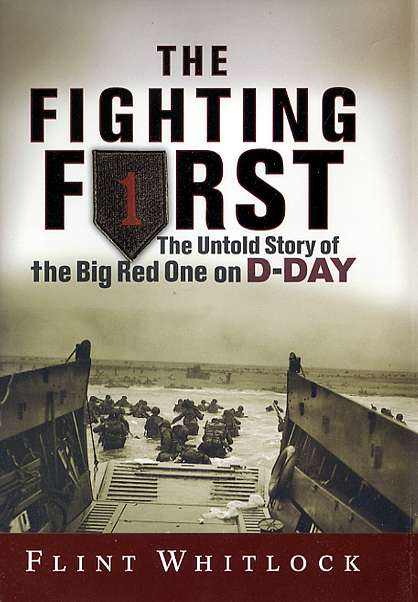 Click the image for a larger view |
The Fighting First The Untold Story of the Big Red One on D-Day by Flint Whitlock |
| This
is "The Untold Story of the Big Red One on D-Day" but so much more!
This Big Red One story begins in North Africa and the Kasserine Pass where "The
first Division stopped the famous 10th Panzer cold in two attacks." It goes
on to Sicily where with Patton where they "suffered greatly." You'd
think they had earned a rest but the only rest they got was back in England preparing
for Omaha Beach. While there, Whitlock gives the reader some real insights into
life for Americans in wartime England. From there, it's on to Omaha Beach and Rommel's Atlantic Wall. Whitlock gives a lot of details of loading landing craft and of the actual landing where it was said by Corporal Michael Kurtz as reported in The Longest Day: "I want all of you Joes to keep your heads down. As soon as we are spotted, we'll catch enemy fire. If you make it, OK. If you don't, it's a hell of a good place to die. Now, let's go." Whitlock also tells of serious errors in the preparation of the Omaha beaches that led to this understated comment: "The beach area of Omaha Beach was almost unscarred. We did not have a single one of those gun emplacements or pillboxes knocked out. Not a good situation. "Now, have they earned a break? No way. They are finally pulled off the line in December, 1944. Guess what was about to happen the morning of 16 December - The Battle of the Bulge! The Big Red One is called upon again! I have often been asked why WWII GIs have waited to talk about their experiences till now and Korean War vets still aren't talking. Perhaps, Whitlock says it best: "Only with other veterans would a soldier speak of the unspeakable for only other veterans would know of the hardships, fear and tragedy, and, yes, even the exultation of combat." This is one hellava book! Don't miss it. | |
|
The Bedford Boys One American town's Ultimate D-Day Sacrifice by Alex Kershaw
| 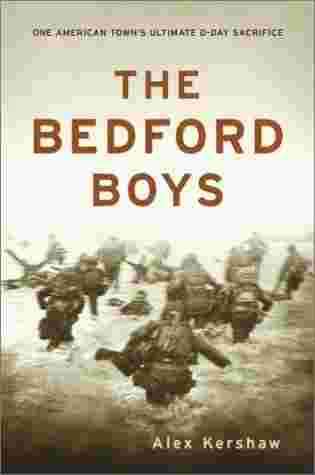 Click the image for a larger view |
| The Bedford Boys, One
American town's Ultimate D-Day Sacrifice by Alex Kershaw, Da Capo Press, 2003 Twenty-two young men, all from a small town in Virginia, made the ultimate sacrifice. Nineteen died during the first wave on Omaha Beach; later, three more died in the campaign that followed. This is their story - theirs and the other young men from Bedford. It is also the story of the people they left behind and the country they were fighting for. This book is sad but inspiring and informative. You will follow these youngsters from a small- town childhood through the tragedy of Operation Tiger to the fierce brutality of Normandy, June 6, 1944. You will find out more than you ever really wanted to know about why you chose the top of six bunks on the Queen Mary (converted to a troop ship) instead of the more convenient lower ones. You will learn, perhaps with some comfort considering today's news, that the country was not totally united during WWII, in spite of what we are now believe. John L. Lewis conducted his strikes, and there were race riots in Los Angeles and Detroit. This book inspired Saving Private Ryan . . . as it will inspire you. | |
|
|
Three Wars.....One Marine by
Lieutenant General Robert Prescott Keller USMC (Retired), What a life! This is an amazing story of a youngster that starts with his running into the on-stage arms of Al Jolson and continues with rubbing elbows with the likes of Charles Lindberg, Chiang Kai Shek, John Glenn and others. It is absolutely fascinating what this man experienced. He began his military career as a Private (became a PFC the same day) and | |
| finished
a Lt. General*. In flight school, he casually
writes of riding a train or car across the country in a time when most Americans
never traveled more than 30 miles from home. He goes on to dealing with the Communist
Chinese in China after WWII. | Lt General Keller | |
| This book is only available through The Publisher, Trent's Prints, 3754 N. Willard Road, Pace, FL 32571. Tel. No. 1-866-275-7124. Cost $18.00, plus $2.50 handling and postage. E-mail Terry@TrentsPrints.com *
This is a three-star General, just one rank below a four-star general - the highest
anyone can expect to go in the military. The five-star general rank was created
during WW II because several American commanders found themselves commanding Allied
officers of higher rank. When General of the Army Omar N. Bradley died in1981,
the five-star ranking was no more. In all, four Army generals, four Navy admirals,
and one Air Force general held the rank. The Army's five-star generals were George
C. Marshall, Douglas MacArthur, Dwight D. Eisenhower, and Omar N. Bradley. The
Navy's five-star fleet admirals were William D. Leahy, Ernest J. King, Chester
Nimitz, and William F. "Bull" Halsey. Henry Arnold was the Air Force's
only five-star general. | ||
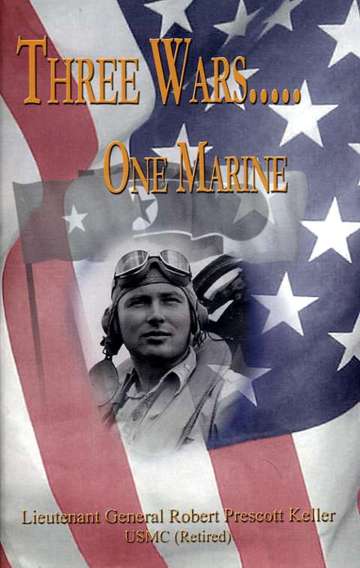
|
D-Day 1944 by Robin H. Neillands and Roderick de Normann, Cold Spring Press, 2004 This book may very well become the definitive book on D-Day, at least from the British viewpoint. It is very detailed, reminiscent of Churchill's The Second World War or Morison's 15 volume History of United States Naval Operations in World War II. Groups are named, often down to the squad level and personal stories from named individuals (British, American and German) are smoothly woven into the story. | |
|
All in all, this is an excellent book on D-day–a little too heavy and detailed, perhaps, for the average, casual reader but for historians, researchers, and avid WWII "junkies" such as those who read Kilroy Was Here, it can't be beaten! | |
|
Three Books from the War Years! Long out of print | ||
| |
|
|
|
''The story is simply and modestly told, and for that reason gains greater dramatic effect than if Reynolds had set himself up as a hero or sounded off on the 'lessons' of the war and what-to-do-with-Japan. ''The impression you get is that he went through hell gracefully, survived his sufferings by a combination of luck and moral and physical stamina. ''The narrative begins with the last ditch fighting at Bataan and goes on to the frightful death march, the various prison camps where death and foulness were gruesomely commingled, and two months' voyage on a Jap 'hell ship' and finally a term as slave laborer in Japan. ''The happy ending comes when the emaciated Reynolds, who had missed death by inches countless times, sees a giant B-29 fly over the POW camp after the surrender, and drop food supplies." ''
Minneapolis Star Journal Reviews from the book jackets. |
"Esther Yerger Hamilton has given. us a vivid account of the war in the Far East of the ruthlessness of the Japanese warriors; of the privation, suffering, sorrow, bravery, and faith of our missionaries who were interned in the Philippines: and of their thrilling and swift liberation by American troops. Above all these things, however, standing out like a beacon light in the darkness of the night, is seen the faithfulness of God to His own amid terror, danger, and death. The war is brought right into the homes of people we know in this historical tale. The book is not without its romantic appeal. In fact, the devotion of John Hamilton and Esther Yerger, their trust in God and confidence in each other, and their reunion and marriage after eight years of waiting and five years of forced separation are as strange as fiction, and will play on the heart-strings of all, satisfying the most sentimental of readers. BONDS is an engaging story full of adventure and love, but a story which is fact and not fable. " E. Schuyler English, Litt.D
|
"Two thousand Emaciated British prisoners-of-war, packed like sardines on wooden shelves in the gloomy holds of a small tramp steamer battling up the China Seas; no medicines provided, dysentery raging; one in every four was destined to die, while the rest went to slavery for the next three years in the coal mines of Honshu and Kyushu. This is the theme of one of the grimmest yet most human stories in the whole literature of World War II. It is told for the first time in this compelling book, taken direct from a factual diary kept throughout 3 ½ years imprisonment in Java and Japan. It is a complete and vivid record of a long, terrible experience - yet gripping as any imagined adventure story. They never lost faith that another day would come, and come, and it did. Ken Attiwill faithfully records ever changing phase of it. The tide of war turned, engulfing an arrogant nation suddenly bewildered. He heard the devastating explosion of The Bomb That Stopped The War . . . and saw Nagasaki swirl up in atomic dust. He saw the Japs in tears over the shame of surrender, the poor puzzled women raking their ashes for food; and then, when P.0.W. relief supplies were air-dropped, the half starved prisoners forgiving their tormentors, sharing their manna from heaven. Here is a tremendously encouraging Story for those who believe ill life and have faith in its good purpose" ..........................Reviews from the book jackets, by Ken Attiwill, Robert Hale LTD, London 1957 |
| These
are three books I discovered. I thought you and or the Kilroy readers might find
them interesting. The books are all true accounts of brutal imprisonment by the
Japanese. They are dated 1946, 1949, and 1957. Bob Cook | ||
|
By Robert J. Bell This is the wonderful story of a high-spirited youth's adventures through WWII. Like the fun loving youngster he was, the story is mostly fun reading but turns to grim sadness in the excellently crafted combat narratives. The story takes you from Buck as a youth in prewar America with an hilarious missed Love-life opportunity to a seasoned warrior forcible relieving the Officer of the Day on his own bridge when he didn't follow the Admiral's orders. The early part is a matter-of-fact telling of a different America where his grandfather had to sell pencils to live and a youngster who split his meager pay to send to his grandmother. His war starts in the Mediterranean with landings in North Africa and Salerno. You later experience with Buck the Battle of Leyte Gulf with its Kamikazes and sail into Tokyo Bay, all the while getting into regular trouble because Buck loves his shore time. What a story! |
| The Aviation Photography of
|
|
I don't usually review publications other than books but my new Ghosts Calendar for 2003 just arrived. To those who love old warbirds, this is a must! As you can see above, the cover is a warbird lovers favorite, the Mustang! But it doesn't stop there. The photographs are absolutely beautiful! January is a early Tuskekee Mustang (without a bubble cockpit) flying formation with a YAK 3M. February is British Meteor, March, a Spitfire, April, a B-25 but I won't give them all away -- look forward to each month as I do. Instead of listing Fathers Day or Flag Day, Phil puts an excellent time line of WWII, historic aircraft events and aircraft specifications. A must for us warbird nuts! See Phil the Ghost's web site at: www.Ghosts.com. | |
|
| Growing Up Before The Innocent Years 1935-1945
|
|
|
What a story! Richard Rohrbacher starts it in 1935 and skillfully makes a youngster spring to life before your eyes. From hanging around a construction site to the first guilty feelings of an adolescent that can't help but fall in love (lust?) with his 8th grade teacher. From the sad musings of old man about dying to the youngster's hilarious fear of dying himself from an "advanced case of acutum masturbatum morbindus," Richard keeps your face in his book. The narrative saddens, as did the whole world, as first, his love (the teacher) left to join the WACs. Then his family, then his friends as ". . . we watched the June graduates trade their gowns and mortarboard for uniforms." They also ". . . wondered if our name was slated to appear on some future casualty roster . . ." This book captures, in an easy readable way, life in America as the world skid inexorably into WWII. *Generations, by Neil Howe, William Strauss, William Morrow & Co. | ||
|
|
These books are available at . . . |
|
|
|
Send Corrections, additions, and input to:

| |
|
Back to Miscellany, page 1 |
| Visitors since June 6, 2000 |
